Anthropic’s $965B IPO hinges on a global compute moat
A first look at how AI infrastructure diversification could redefine capital allocation in tech.
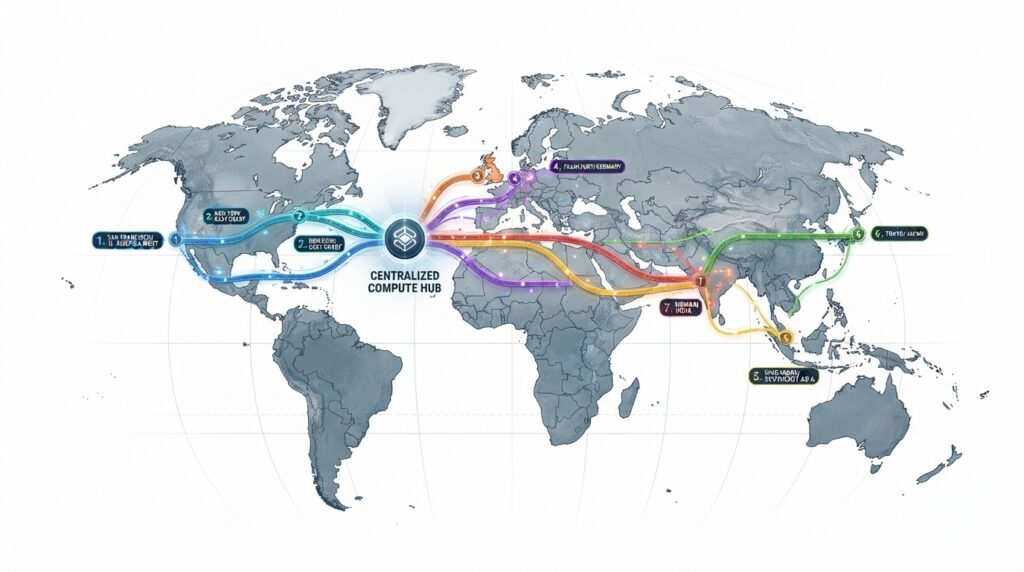
Why Anthropic’s compute strategy is the new blueprint
for AI IPOs
Anthropic’s push to go public at a $965 billion valuation is less about its model’s capabilities and more about the industrial-scale compute infrastructure underpinning it. By stitching together seven compute corridors across three continents, the company isn’t just optimizing for cost. It’s building a structural advantage that could force every AI startup and fund to rethink capital efficiency. (Forkast.news, 2026)
Founders raising capital and LPs deploying into AI should study this playbook. The rules of the game have changed. Compute isn’t a variable cost anymore. It’s a moat.
The compute corridor thesis: hardware, energy, and geography
as leverage
Anthropic’s seven corridors — spanning North America, Europe, and Asia — are designed to mitigate three existential risks for AI companies: hardware scarcity, energy volatility, and geopolitical friction. Each corridor combines three layers:
Hardware diversity: GPUs, TPUs, and custom silicon
Anthropic isn’t betting on one chip. Its corridors include:
- NVIDIA H100/H200 clusters in U.S. corridors (e.g., Texas, Arizona) for high-performance training.
- Google TPU v5e pods in Singapore and Ireland for inference and fine-tuning.
- Custom ASICs (e.g., Amazon’s Trainium) in European corridors to reduce dependency on NVIDIA.
- Edge deployments in Japan and South Korea using AMD Instinct MI300X for low-latency inference.
This isn’t just redundancy. It’s a hedge against chip supply shocks. When NVIDIA’s lead times stretched to 18 months in 2025, Anthropic’s Singapore TPU pods kept training cycles uninterrupted. (Forkast.news, 2026)
Energy arbitrage: baseload, renewables, and grid stability
Compute corridors are selected for energy economics, not just proximity to talent. Anthropic’s corridors prioritize:
- Nuclear power in France and Sweden (e.g., Corridor 3 in Lyon) for 24/7 baseload at ~$0.04/kWh.
- Hydroelectric dams in Norway (Corridor 5) and Canada (Corridor 2) for cheap, renewable energy.
- Solar+storage in Texas (Corridor 1) and Arizona (Corridor 4) to capitalize on daytime peaks.
- Geothermal in Iceland (Corridor 6) for ultra-low-cost, carbon-negative compute.
The result? Anthropic’s energy costs per FLOP are 30-40% lower than peers locked into single-grid markets. For funds, this means portfolio companies must now model energy as a first-order variable in unit economics.
Geopolitical resilience: avoiding the China chokehold
Three of Anthropic’s corridors are outside the U.S.-China tech war zone:
- Ireland (Corridor 3) for EU market access and regulatory stability.
- Singapore (Corridor 5) as a neutral hub for Asian compute demand.
- Japan (Corridor 7) for proximity to semiconductor supply chains without U.S. export restrictions.
This isn’t just about avoiding sanctions. It’s about ensuring uninterrupted access to the best chips, talent, and customers. For LPs, this signals a new era: AI startups must diversify compute geography before they scale, or risk being held hostage by geopolitics.
The capital implications: why this changes the funding game
Anthropic’s compute strategy has three direct consequences for venture and private markets:
Cap tables will reflect infrastructure risk
Founders raising Series B+ should expect LPs to ask:
- Where is your compute corridor? If the answer is "AWS us-east-1," expect pushback.
- What’s your energy mix? A 100% coal-powered data center is a red flag in 2026.
- Do you have multi-supplier hardware contracts? NVIDIA-only shops are now viewed as single-point-of-failure bets.
This isn’t just diligence. It’s a shift in how capital is allocated. Funds like Sequoia and a16z are already modeling compute corridors into their investment theses, treating them as a proxy for a company’s long-term defensibility.
The rise of compute-as-a-service (CaaS) startups
Anthropic’s playbook is accelerating a wave of infrastructure startups:
- Compute brokers: Platforms like CoreWeave and Lambda are aggregating multi-vendor, multi-region capacity, offering startups the ability to spin up H100s in Texas or TPUs in Singapore without signing long-term leases.
- Energy-fintech hybrids: Companies like Voltalis and DeepMind Energy are trading compute cycles against renewable energy credits, letting startups lock in sub-$0.03/kWh power for 3+ years.
- Geopolitical compute routers: Startups like Neutral Compute and GeoCompute are building APIs that dynamically route workloads based on chip availability, energy prices, and export controls.
For VCs, this is a greenfield opportunity. The next billion-dollar infrastructure startup won’t build a better model. It’ll optimize the industrialization of compute.
LPs will demand compute diversification in fund mandates
Limited partners are starting to treat compute as a portfolio-level risk:
- Energy hedging: CalPERS and other institutional LPs are requiring GPs to disclose energy mix and grid dependencies for portfolio companies.
- Hardware diversification clauses: Some LPs are inserting clauses in fund agreements that cap exposure to any single chip vendor (e.g., no more than 30% of compute budget on NVIDIA).
- Geographic spread: LPs like BlackRock are pushing for portfolio diversification across corridors, not just sectors.
This isn’t just about risk management. It’s about ensuring that the fund’s returns aren’t tied to a single point of failure. For founders, this means your pitch deck must include a compute corridor slide — not as an afterthought, but as a core part of your defensibility story.
What founders should do today
If you’re raising capital in 2026, Anthropic’s playbook isn’t optional. It’s the new baseline. Here’s your action plan:
Map your compute corridor before your Series B
- Step 1: Identify your top 3 energy sources (e.g., hydro in Canada, nuclear in France, solar in Texas).
- Step 2: Select hardware suppliers across at least two vendors (NVIDIA + AMD/Google/Intel).
- Step 3: Lock in multi-year energy contracts. Startups like Voltalis and DeepMind Energy can help.
Build a hardware-agnostic stack
- Avoid vendor lock-in. Use frameworks like Ray, vLLM, or Hugging Face’s Accelerate to abstract away chip dependencies.
- Pressure-test your stack on non-NVIDIA hardware. If it breaks, fix it now.
Treat energy as a first-class unit in your unit economics
- Model energy costs per 1,000 tokens. If it’s >$0.001, you’re already uncompetitive.
- Negotiate power purchase agreements (PPAs) with renewable providers. Startups like LevelTen Energy can help.
Prepare for LP diligence on compute
- Your pitch deck should include:
- A map of your compute corridors.
- Energy mix and cost per FLOP.
- Hardware vendor diversification plan.
- Geopolitical risk mitigation (e.g., avoiding China-only supply chains).
What LPs should ask GPs tomorrow
If you’re deploying into AI funds, Anthropic’s strategy should inform your due diligence:
- Hardware concentration: What’s the fund’s exposure to any single chip vendor?
- Energy risk: How are portfolio companies hedging against energy price volatility?
- Geographic spread: Are investments concentrated in one region, or diversified across corridors?
- Infrastructure clauses: Does the fund’s LPA include compute diversification requirements?
The funds that ignore this will face write-downs. The funds that embrace it will define the next decade of AI capital allocation.
The bottom line
Anthropic’s $965 billion IPO isn’t just about its model. It’s about the industrial-scale compute infrastructure that makes the model possible. For founders and LPs, this is a wake-up call: compute isn’t a cost center anymore. It’s a moat.
The companies and funds that master this first will own the next era of AI.
What to do next: Audit your portfolio’s compute corridors today.
Sources & references
Read the source PDF (opens in a new tab)
- Forkast.news · 2026
Part of Anker Intelligence — perspectives on private capital, frontier markets, and venture flows. Sources and figures reflect the information available at publication. This article is not investment advice.